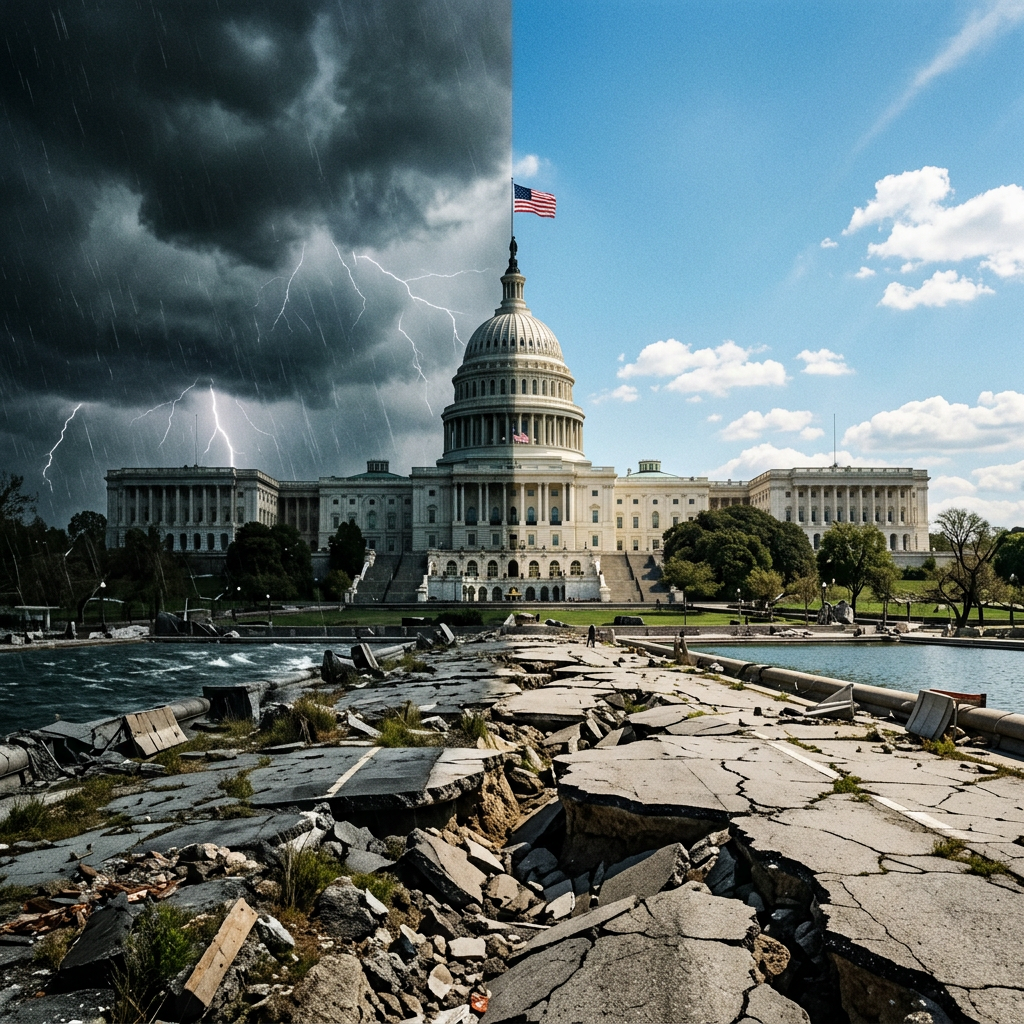
America does not suffer from an excess of political disagreement. It suffers from a collapse of civic restraint.
Disagreement is inevitable in a pluralistic democracy. In fact, it is essential. But in recent years, political identity has increasingly become a moral sorting mechanism—one that divides neighbors into abstractions and encourages citizens to interpret disagreement as evidence of a personal defect. When politics becomes a license for contempt, democratic life begins to degrade.
This is not an argument against strong convictions or vigorous debate. It is a warning about what happens when disagreement hardens into hatred. If political engagement depends on despising those on the other side, then polarization is no longer merely a condition to be managed—it becomes a behavior that is actively reinforced.
The trouble is not politics itself. The trouble is the ease with which political disagreement now slides into moral dismissal.
Hate is politically efficient. It simplifies complexity and offers certainty without reflection. It provides the emotional reward of moral superiority while relieving individuals of the burden of self‑examination. It feels clarifying, even energizing. But what it clarifies is not truth—it clarifies who belongs and who does not.
Over time, this mindset reshapes public life. When citizens come to view one another as enemies rather than as mistaken compatriots, deliberation becomes impossible. Disagreement turns performative. Escalation replaces persuasion. The objective shifts from solving shared problems to humiliating the opposing side.
A society organized around contempt cannot govern itself well.
The cumulative effect of this dynamic is not moral progress but social brittleness. Trust erodes. Good faith is treated as naïve. Every action is interpreted through the most hostile available lens. Even legitimate criticism is received as an attack, because the expectation of cruelty has become normalized.
History offers little evidence that hatred has ever strengthened a nation. What it reliably does is justify excess, excuse cruelty, and flatten moral complexity. Societies unravel not only because of failed institutions or irresponsible leaders, but because ordinary citizens grow accustomed to speaking and thinking in ways that make coexistence untenable.
There is also a more personal cost. Hate does not merely damage its targets; it reshapes those who harbor it. Sustained anger narrows empathy and rewards the worst cognitive habits—overgeneralization, mind‑reading, and moral absolutism. It trains people to feel more certain while thinking less carefully. Over time, it reduces the ability to recognize decency when it appears in unfamiliar forms.
This is why political hatred so often feels righteous even as it corrodes character. It provides emotional clarity while quietly degrading moral perception.
None of this requires pretending that all political positions are equally sound or that all behavior is equally defensible. Moral judgment is unavoidable. Some ideas are genuinely dangerous. Some actions deserve condemnation. But judgment need not require dehumanization. A society can reject ideas without rejecting entire classes of people. It can name wrongdoing without assuming that everyone associated with it is defined by it.
The difference matters.
One of the most corrosive habits of contemporary politics is the tendency to think in aggregates rather than individuals. Abstract groups are easy to hate; individuals are harder. When arguments are directed at caricatures, cruelty comes easily and nuance disappears.
A practical discipline is to resist this abstraction. When anger flares, it is worth calling to mind someone you actually know who holds opposing views and asking a basic question: What do I know to be decent or admirable about this person? The exercise does not require agreement or concession. It requires honesty. Most people, when forced to reckon with real human complexity, find their outrage softened—not eliminated, but moderated.
This shift is not sentimental. It is functional.
Democratic life depends not only on laws and institutions but on habits of character. Self‑government assumes a citizenry capable of restraint—people who can argue fiercely without denying one another’s humanity. When that capacity erodes, even strong institutions strain under the weight of mutual suspicion.
Kindness, in this sense, is not a personality trait. It is a civic discipline. It does not depend on reciprocity or approval. It is a commitment to act from principle rather than provocation. People who practice restraint do not require others to earn humane treatment; they extend it because they regard it as a baseline obligation of citizenship.
This is not weakness. It is moral seriousness.
A culture that confuses cruelty with courage will eventually lose both. Harshness does not strengthen arguments; it weakens them. The satisfaction of “scoring points” often comes at the cost of widening the very divisions that make collective solutions impossible.
If American democracy is to recover a measure of stability, the work cannot be outsourced entirely to elections or institutions. It begins at a smaller, less visible scale—in habits of speech, in assumptions about motive, and in the willingness to interpret disagreement without reflexive hostility. It is not plausible to demand restraint from public figures while practicing excess in daily civic life.
This does not require suppressing conflict or avoiding disagreement. It requires refusing to let disagreement become an excuse for cruelty.
A Diagnostic Conclusion
The analytically useful question is not whether political anger is justified. In a fragmented society, anger is an expected response. The more relevant question is how that anger is structured, incentivized, and normalized.
Contemporary political culture systematically rewards expressions of moral hostility while penalizing restraint. Attention economies favor intensity over proportion and clarity over accuracy. Social and media systems amplify conflict because conflict sustains engagement, while institutions that once moderated rhetoric—local civic organizations, party leadership, and shared social norms—have weakened or disappeared. In such an environment, contempt is not an aberration; it is a rational adaptation.
Under these conditions, hatred becomes less a failure of individual virtue than a predictable outcome of institutional design. People learn which emotional registers produce affirmation and which invite suspicion. Over time, cruelty is interpreted as authenticity, while restraint is reframed as evasion or complicity. The baseline expectation shifts: bad faith is assumed, escalation is normalized, and charity is treated as a liability.
The consequences are not merely emotional but epistemic. A political culture saturated with contempt loses the ability to distinguish disagreement from threat, error from malice, or opposition from illegitimacy. When every conflict is framed as existential, compromise becomes indistinguishable from surrender. Politics shifts from negotiation to permanent mobilization—a mode historically associated with poor decision‑making and institutional decay.
Democratic systems can accommodate intense disagreement. What they cannot accommodate indefinitely is the widespread belief that fellow citizens are not legitimate participants in the political order. Once that belief takes hold, persuasion ceases to function, and coercion—formal or informal—becomes the primary means of resolution.
If American democracy is under strain, the explanation will not lie solely in elections, leaders, or constitutional mechanisms. It will also lie in the accumulation of smaller failures: the routinization of contempt, the erosion of interpretive charity, and the replacement of civic disagreement with moralized hostility.
These failures rarely announce themselves as crises. They appear as habits—of speech, of attention, of assumption. And once those habits stabilize, they are difficult to reverse.
The relevant question, then, is not what emotions political life provokes, but what kind of political system those emotions are training citizens to sustain. A democracy organized around hatred may be capable of mobilization, but it is poorly equipped for self‑government—and unlikely to remain democratic for long. Americans must admire leaders must appeal to the better angels of our nature, not those who appeal to the worst demons of our history.
Find me also @beauxbonhoeffer.bsky.social and at beauxbonhoeffer.substack.com